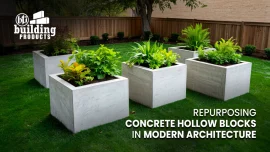


Concrete Hollow Blocks: The Best for Urban Projects?
The Concrete Hollow Blocks have emerged as a norm in the modern world of construction, especially in a city where time, cost and performance are of prime importance. But do Concrete Hollow Blocks deserve to be ranked as the number one building material in city construction? Let’s look into the areas that make Concrete Hollow Blocks stand out, their applications of Hollow Blocks and whether they deserve to rank number one in city construction.
Why Urban Projects Prefer Concrete Hollow Blocks
In a city, where construction is a never-ending task, it is of prime importance to complete a building within a short period of time, while keeping costs and performance in check. Materials like clay bricks have been in use for decades, but they come with a number of disadvantages, such as a slower rate of construction, increased labor costs and a lack of flexibility in use. This is where Concrete Hollow Blocks come into the picture, as they consist of cement, aggregate sand and water, combined in a particular proportion and have hollow cores, which make them different from other solid core building blocks.
One of the main attractions of using hollow blocks is their lightness compared to using solid blocks or bricks. This lightness results in reduced overall weight, which makes them easier to handle on site. In addition, this lightness reduces the dead load of foundations. In urban planning and construction, this is particularly important in the construction of high-rise buildings. This lightness of hollow blocks reduces the cost of reinforcement and foundation works. This is particularly important in urban planning and construction, where land is scarce and every square foot counts.
Faster Construction
Hollow blocks are particularly attractive to builders because of their speed of construction. Concrete hollow blocks have an added advantage over other building materials. For one block, only one brick is needed. This makes construction faster. In urban planning and construction, time is of the essence. This ensures timely completion of construction. This saves on costs since the sooner the building is complete, the sooner it can be occupied. In addition, the shape and size of hollow blocks ensure straightness in construction.
Coming to the uses of Hollow Blocks, they can be said to be extremely versatile. For instance, they can be used for load-bearing structures in residential apartments, commercial buildings and even mid-rise offices. The hollow nature of the blocks facilitates the incorporation of reinforcement bars and grout, thereby providing additional strength to the structure, particularly in seismic zones and areas with moderate wind speeds.
Better Thermal Insulation
Insulation can be said to be the hidden gem in this case. The hollow nature of the block provides natural insulation to the structure, thereby maintaining a cool atmosphere in the scorching heat of the city. In environmentally friendly cities striving to become green cities, the hollow section of the block can be filled with insulation materials to improve performance and minimize costs incurred in maintaining the structure.
Structural Strength with Reduced Weight
Another factor that should not be neglected is the durability of the material. Well-made Concrete Hollow Blocks are far more resistant to fire, moisture, pests, and weather compared to organic materials. They will not rot, warp, nor attract termites, making them perfect for use in humid and coastal urban settings. When reinforced, they can withstand compressive forces well, perfect for multi-story buildings that do not settle nor crack when properly installed.
Without reinforcement, they can only bear a certain level of weight compared to cast concrete. A drawback that some builders might find is that the material, when installed as a block, needs to be plastered for a more polished finish, thereby increasing the overall cost. In places that experience earthquakes, careful design must go into the use of the material to make it comparable to cast concrete.
Summing up, Concrete Hollow Blocks are not necessarily the absolute “best” option in every situation—poured concrete might be the way to go for skyscrapers and maximum durability requirements. But in many cases, Concrete Hollow Blocks tend to be the most feasible option. This is because their strength, speed, cost-effectiveness, and flexibility are perfectly suited to the requirements of a growing metropolis—more, faster, smarter, and cheaper.
So, if you’re planning to build something in a growing metropolis, one of the most intelligent decisions you can make is to take seriously the option of Concrete Hollow Blocks. Not only do they build walls; they build the future.